

CAMPAIGN FOR JUDICIAL ACCOUNTABILITY AND REFORMS
6/6 basement, Jangpura B, Delhi – 110014
judiciareforms@gmail.com, judicialreforms.org
Executive Committee: Prashant Bhushan (Convenor), Cheryl D’souza (Secretary), Nikhil Dey, Alok Prasanna Kumar, Venkatesh Sundaram,Indu Prakash Singh, Anjali Bhardwaj, Amrita Johri, Annie Raja, Beena Pallical, Siddharth Sharma, Indira Unninayar, Vijayan MJ, Vipul Mudgal ,Koninika Ray, Meera Sanghamitra, Prasanna S, Sai Vinod, Apar Gupta, Anurag Tiwari Prashant Bhushan (Convenor), Cheryl D’souza (Secretary), Nikhil Dey, Alok Prasanna Kumar, Venkatesh Sundaram, Indu Prakash Singh, Anjali Bhardwaj, Amrita Johri, Annie Raja, Beena Pallical, Siddharth Sharma, Indira Unninayar, Vijayan MJ, Vipul Mudgal,Koninika Ray, Meera Sanghamitra, Prasanna S, Sai Vinod, Apar Gupta, Anurag Tiwari
Statement on
The Supreme Court’s hearings and orders in the NCERT text bookcase
4th April 2026
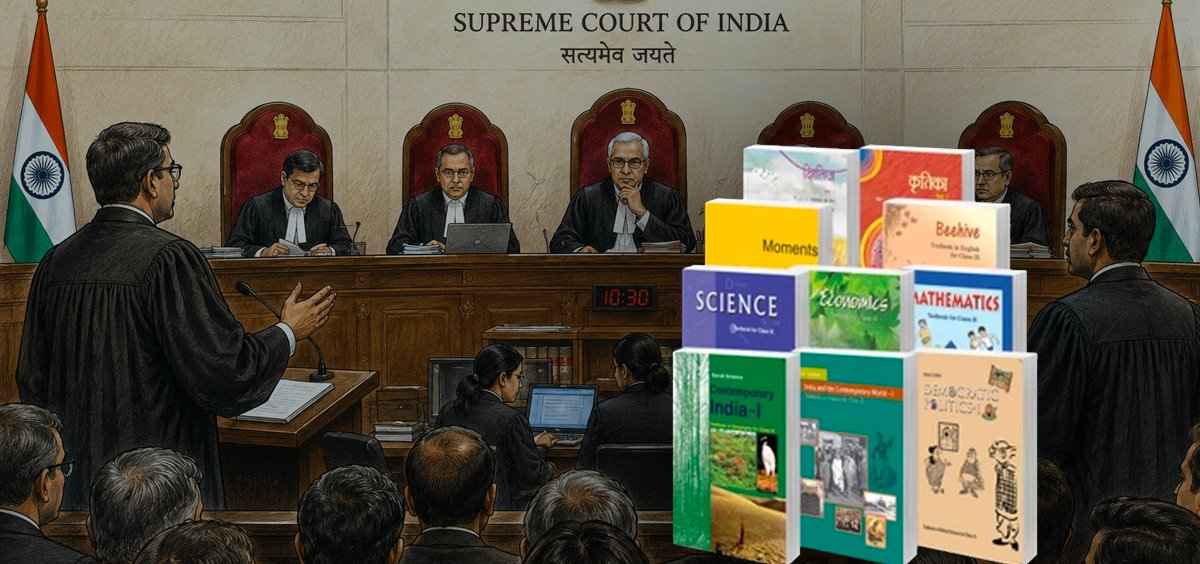
The Campaign for Judicial Accountability and Reforms (CJAR), expresses its concern over the Supreme Court’s recent order in a suo motu proceeding over a chapter on the judiciary, in a social science text book for class 8 students. The order directs, first, a complete blanket ban on the social science textbook of the National Council of Educational Research and Training (NCERT), second, a direction to penalise/dissociate three drafting members of the Textbook Development Team (TDT) for including corruption in the judiciary as among the other challenges facing the judiciary today and directed to dissociate them from any public funded academic work, and third, a clear warning against “mischief mongers” on social media who try to spread or amplify the material to malign the judiciary.
A sequence of the material events in the case is given below in which a 3 judge bench of the Supreme Court with Justices Surya Kant (CJI), Joymala Bagchi and Vipul M. Pancholi took up suo motu proceedings:
1. The case concerns Chapter 4 titled “The Role of the Judiciary in our Society” with the sub-topic “Corruption in the Judiciary” in a text book on Social Science for Grade 8 (Part 2) published by the NCERT, which has been termed by the Court as the, “offending chapter”.
2. The Court has expressed reluctance to reproduce “the full contents of the chapter” and yet, proceeded to conclude that:
a. The chapter “makes prominent reference to hundreds of complaints received against the judiciary, clearly indicating, as if no action was taken”.
b. “A few words from the statement of a former Chief Justice of India, suggesting that the judiciary itself has acknowledged that lack of transparency, accountability and institutional corruption”.
c. “Not only this, the article further goes to declare that “people do experience corruption of various levels of the judiciary…””
3. Based on the above concluded, that the contents of the, “offending chapter”, were, “reckless, irresponsible, contemptuous, and motivated” based on a mere “prima facie examination of the book’s contents.” And further concluded that when read in conjunction with the NCERT Director’s response, the book’s contents revealed, “a discernible underlying agenda to undermine the institutional authority and demean the dignity of the judiciary” that if allowed to go unchecked, would erode the sanctity of the judicial office among the public and the impressionable minds of the youth.
4. The Court has imposed a “complete blanket ban” on the entire text book through its very first order on 26.02.2026, and proceeded to issue show-cause notices under the contempt law, upon The Secretary of School Education and Literacy (Ministry of Education) Government of India and The Director of NCERT.
5. Through its second order on 11.03.2026, decided that the three contributing authors [named by the NCERT as having drafted the relevant chapter as part of the Text Book Development Team (TDT)], “did not have reasonable informed knowledge about the Indian judiciary” and that they, “deliberately and knowingly misrepresented the facts in order to project a negative image about it to students of Class 8, who are at an impressionable age”. It then summarily banned all three authors from continuing, “to be associated, in any manner whatsoever” with preparation or finalization of any curricula or finalization of text books in the future, and further, directed the Government, and all public universities and institutions receiving government funds, to “dissociate” from these 3 persons forthwith. It left it open to the members to approach it for modification, with an explanation that they might choose to tender.
Based on the above CJAR voices it concerns with responsibility and with the hope for institutional reflection by the Supreme Court of India as the custodian of the Constitution of India.
We note with anguish that the Supreme Court’s order banning the Class 8 NCERT textbook and barring its authors was passed without adherence to natural justice. The affected parties, including authors Prof. Michel Danino, Ms Suparna Diwakar, and Mr Alok Prasanna Kumar were neither given notice nor adequate opportunity to present their case. The principle of audi alteram partem was not followed. The Court mechanically arrived at a conclusion that the chapter carried, “a discernible agenda to undermine the institutional authority and demean the dignity of the judiciary”, by its very first hearing. This conclusion is factually incorrect. In fact, the 18-page chapter opens with a quote honouring the judiciary, details its structure, highlights landmark cases protecting fundamental rights, and devotes only four pages to challenges and barely one page to corruption. The latter referencing the Bangalore Principles, the CPGRMS accountability mechanism, and a speech by former CJI Justice B.R. Gavai. The section ends by noting, “constant efforts being made at both union and state levels to build faith and increase transparency in the judicial system.” This balanced, constructive approach was wholly overlooked.
The Order also constitutes judicial overreach into the executive’s domain. NCERT is an autonomous body and its textbooks were developed under the National Curriculum Framework 2023 through structured expert committees. Without examining or reasoning as to illegality, the Court banned the book and assumed the role of pedagogical expert which is a position it is not equipped to occupy. The authors’ right to reputation under Article 21 was summarily dispensed with and academic freedoms and free speech under Article 19(1)(a) were overridden without reference to the Court’s own settled jurisprudence against prior restraint. The invocation of criminal contempt under Section 2(c) of the Contempt of Courts Act for discussing judicial challenges in a textbook is a chilling use of a provision rooted in the antiquated doctrine of, “the king can do no wrong”.
Notably, challenges facing the legislature and executive that include corruption are discussed in Classes 7 and 8 textbooks without controversy. Hence, the judiciary has not been singled out but has been reasonably criticised as an institution that is not perfect and requires corrective steps as other branches of the state. CJAR urges the Supreme Court to revoke the ban on the textbook and its authors, and to permit healthy public discussion of the judiciary’s accomplishments alongside its challenges rather than consigning them to whispers for fear of contempt.
[Disclosure: Alok Prasanna Kumar is a member of CJAR. He has not participated in the proceedings nor in the preparation of this statement.]