

This Article was originally Published in Constitutional Law and Philosophy by Gautam Bhatia, 02.09.2026
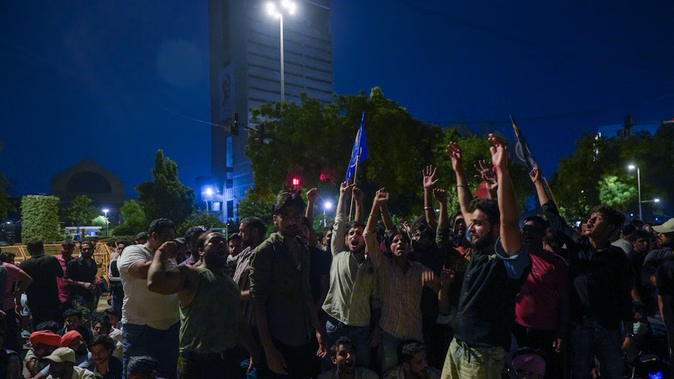
In an order passed yesterday, the Supreme Court invoked its extraordinary powers under Article 142 of the Constitution to quash, en masse, the various police FIRs registered in the wake of the protests organised by the Cockroach Janta Party [“CJP”] in July. Oral reports of the hearing, as well as the text of the order itself, suggest that this was, in essence, judicial imprimatur upon a negotiated settlement between the CJP and the central government, where – in return for the CJP calling off its planned protests on 5th September, all remaining FIRs would be withdrawn.
While the order has been hailed in the press, it raises certain fundamental concerns around legality, judicial power, and the uneasy relationship between the Supreme Court and the rule of law.
First, Article 142 of the Constitution confers upon the Supreme Court the power to do “complete justice” in a case before it. By now, reams have been written about the uses and abuses of this article (see, on this blog, here, here, and here). It is accepted that Article 142 can be invoked to fill in a statutory vacuum in order to do justice in a specific case, but it cannot be used to supplant or contradict a statutory scheme. Admittedly, as the links above show, this is an injunction that is honoured more in the breach. The CJP order appears to be yet another instance of this phenomenon, as there is an extant statutory machinery that determines both when the criminal law is set in motion, and when it can be halted. A mass quashing of FIRs – which, it seems, were not even before the Court – as the culmination of a negotiated settlement between the State and a non-State organisation not only forms no part of the statutory scheme, but is in direct conflict with it. Not only that, it is in direct conflict with the fundamentals of criminal law, which are premised on individual responsibility: an FIR may be quashed if, on a perusal of its contents, the Court finds that no offence has been made out on its own terms or if it is clearly mala fide (a very high bar). But FIRs cannot be quashed in bulk – without judicial scrutiny of their contents – as part of a negotiation between two parties (including where one party is the State).
To this, it may be objected that given the procedural difficulties and bottlenecks involved with “withdrawing” a large number of FIRs once they have been filed, this was the only way to cut the Gordian knot, so to say, and bring all of this to a close. That is correct – and it is also correct for a reason. There is a reason why constitutional democracies do not vest in courts and judges sweeping powers to determine when en masse criminal proceedings are to come to an end (or, for that matter, when they are to be initiated). Criminal procedure exists not because we love making things cumbersome and inefficient, but as a vital constraint upon the exercise of vast, unregulated, discretionary power, whether that comes from the executive or from judges. In the CJP order, the Supreme Court simply assumes such a vast, unregulated, discretionary power upon itself, without any debate or deliberation. And it is a power that, once assumed, can be used for just about any purpose, because it belongs not to the realm of law, but to the realm of pure judicial discretion.
As an addendum to this, it must be noted that para 7 of the order carves out an exception within this exceptional use of power, for “2873 individuals allegedly having serious criminal antecedents”, and who were present at the protest site. As I noted in my initial piece on the first CJP order, this division is questionable: if this is in the nature of a general judicial amnesty, then on what legal basis is an individual’s prior record (as per the National Crime Records Bureau Database) a ground to exclude them from that amnesty? Here is discretion piled on discretion.
This leads to the second problem with the CJP order, which is the Supreme Court’s declaration that the order is “not to be treated as precedent.” Among all the recent judicial inventions that have come from the Supreme Court, I find this to be the most indefensible (see here, here, and here). The fundamental task of a constitutional court is to adjudicate a dispute before it, apply legal principles, and deliver a binding judgment. It is one of the most basic features of a system governed by the rule of law that, indeed, legal disputes are to decided on the basis of principles, and are not one-time issuance of decrees that other – and future – courts can adhere to or depart from as they choose, and issue other, one-time decrees based on whatever facts are before them. It is therefore outside the bounds of a constitutional court’s legal authority to deliver a judgment and, in the same breath, efface the legal standing of that very judgment, and pretend that it never happened. Once again, this takes us from the forum of legal principle to the forum of pure discretion, where courts are now entirely unshackled from adhering to what law or precedent requires of them; instead, they can simply decide according to their discretion, and just tack on “not to be treated as precedent” at the end.
These two points bring me to my overarching critique of the Court’s conduct. The real issue which necessitated these proceedings – as everyone knows – is that the machinery of criminal law is heavily skewed in favour of the State. Initiating criminal legal proceedings against an individual is virtually costless; procedural safeguards at those stages are weak and ill-enforced; and compensation for malicious prosecution is non-existent. It is this architecture of criminal law that facilitates the mass filing of FIRs against student-protesters in the first place. Now, there are many ways that an active, liberty-preserving judiciary can respond to this: by striking down certain provisions of the criminal procedure code (such as the broad and vague “unlawful assembly” clauses), introducing and enforcing procedural safeguards, and developing a rigorous doctrine of compensation and damages for malicious State action. All of this, however, would require the application or evolution of legal principle, which would tie the Court’s hands and no longer permit such one-time acts of pure judicial discretion.
And that is the problem: time after time, in the history of the Supreme Court, when it has been faced with scrutinising the constitutionality of the coercive criminal legal apparatus, the Court has done two things. First, it has upheld constitutionality, and left these laws on the statute books. But at the same time – and secondly – it has reserved to itself the power to override the application of those laws at its discretion. Previously, when examining the Court’s extraordinary “interim bail order” in Arvind Kejriwal’s case back in 2024, I had written this:
But it also contributes and entrenches the same problem, because what the Supreme Court is doing is adding yet another distortion to an already distorted criminal justice system. On the one hand, when the Court is actually given the opportunity to curtail executive impunity, protect personal liberty, and safeguard the rule of law through its normal jurisdiction – such as in the challenge to the PMLA – it responds by not only upholding draconian laws, but increasing and expanding state power. And then – in orders like yesterday’s – it retains for itself the discretionary power to decide when, and for whom, it can make an exception. But this is not the rule of law: this is the Supreme Court using personal liberty as a form of patronage, deciding whom to dole it out to and whom to withhold it from, on the basis of opaque criteria …
The other problem here … is, of course, that this is a power that only the Supreme Court will wield: as we have seen in the case of not only Arvind Kejriwal but those of others as well, orders such as yesterday will rarely – if ever – be forthcoming from the trial court or the High Court. Orders such as these thus tend to further centralise power in an already heavily over-centralised Supreme Court. Thus, instead of a legal system where courts at all levels are deploying legal standards that are solicitous of personal liberty when it comes to arrest and custody, you have the near-mechanical endorsement of executive power in the courts below, followed by the possibility of the Supreme Court choosing to invoke this extraordinary remedy [here, of Article 142] … this is not how a healthy legal system works.
The CJP order is an extreme version of the “liberty as patronage” approach of the Supreme Court. And what is perhaps most alarming is that the dangers of such a model are entirely unrecognised and undebated: since yesterday, one has witnessed an uncritical celebration of the CJP order (including, regrettably, from academics, whose job it is to raise these debates), a celebration that seems to stem purely from the belief that the order achieved the “right” outcome. It is, however, this obsession with outcomes that has long bedevilled the public conversation around the Supreme Court, and it is an obsession that, one day, will put an end to whatever remains of the rule of law.