

This article was first published on thewire.in on 28.10.2026 by Ramsha Sartaj
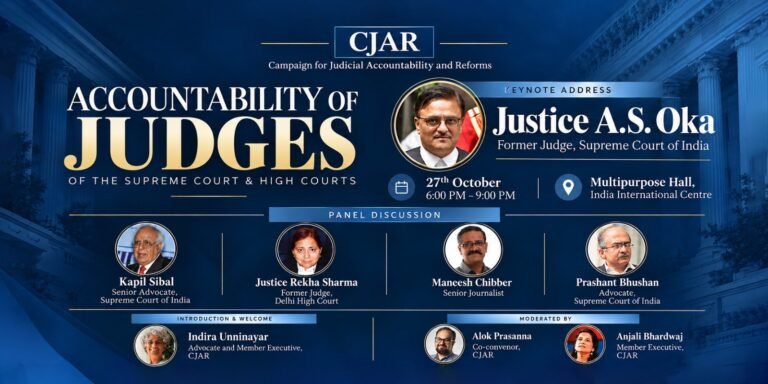
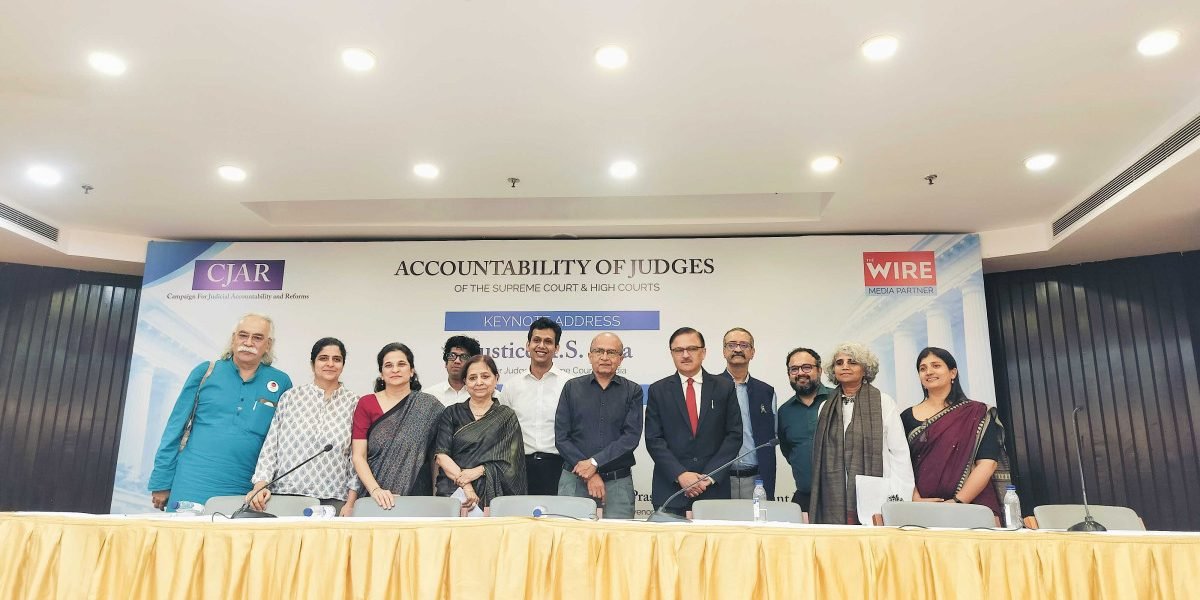
New Delhi: In a packed hall, seats ran short on October 27, as the India International Centre in New Delhi heard a discussion on how judges of the Supreme Court and high courts can be held accountable.
The event, organised by the Campaign for Judicial Accountability and Reforms (CJAR) with The Wire as media partner, had among its audience youth leader Neha Bora, psephologist Yogendra Yadav, former Supreme Court judge Justice Madan Lokur, and a large number of law students.
Advocate Indira Unninayar of CJAR welcomed the audience with a short note on judicial accountability, which she said, means judges honouring the constitutional principles in their oath. She cited repeated adjournments in bail hearings of young people jailed by the government and also pointed to the Special Intensive Revision (SIR) of voter lists.
Justice A.S. Oka
Former Supreme Court judge Justice A.S. Oka in his keynote speech emphasised that judicial accountability must be understood as a systemic issue rather than through isolated incidents. He said that courts and judges must first be accountable to litigants. He identified several areas requiring reform, including case listing, cause lists, allocation of cases, time-bound judicial orders, public criticism, judicial transfers and vacancies.
Case listing
Justice Oka suggested automating certain administrative functions to reduce reliance on established practices and discretion. He said that there should be no need for litigants to engage senior advocates to have their cases listed and mentioned before a court. Instead, he argued, cases should ordinarily be listed within two to three days of filing
Cause lists
He pointed out that daily cause lists often contain 90 to 100 cases, although a bench may be able to hear only 40 to 50. This gives the registry considerable power over which cases would actually be heard. He proposed listing only as many cases as a bench could realistically hear and ensuring that cases left unheard are taken up the following day, so that people do not have to wait for another two to three months for their case to be listed.
Roster allocation
Justice Oka urged for greater transparency and accountability in allocating cases to judges. Since several benches may be competent to hear the same category of cases, the process for determining which bench receives a particular matter should be clearly explained.
Time-bound orders
He questioned orders by higher courts to lower courts directing to dispose of cases within specified periods because such directions may be issued without adequate consideration of conditions on the ground. They also create competing priorities for judges who must balance existing cases against matters subject to deadlines imposed by higher courts. This, he argued, risks creating a “VIP line” for wealthy litigants who can approach higher courts for time-bound orders, while ordinary litigants may wait 20 to 30 years for their cases to be resolved.
Public criticism
Justice Oka said that judicial decisions should be open to public discussion and constructive criticism. A judgment should not automatically be labelled biased or incorrect merely because it favours the government. A constructive approach therefore would balance the criticism. This would in turn strengthen the mechanism of transparency.
Transfers, vacancies and trial courts
The former judge also called for greater transparency in judicial transfers and highlighted the persistent vacancies in the judiciary, stressing that recruitment must keep pace with the need for judges. He noted that discussions on judicial reform often concentrate on the Supreme Court and high courts, despite the fact that many of the disputes affecting ordinary citizens arise in trial courts. He urged that such discussions should extend beyond Delhi and take place across the country.
Kapil Sibal
The Senior Advocate, Kapil Sibal, while taking the podium said, “Justice Oka has looked at the courts from within, but we are lawyers, we look at the court from the outside and find out what’s happening within.”
Sibal distinguished between the judicial side, where judgments are publicly debated, and the administrative side, where decisions often lack transparency and accountability. He questioned the appointment of high court Chief Justices and the selection of judges for special courts hearing Prevention of Money Laundering Act (PMLA) cases, alleging that these cases largely involved opposition politicians. He also warned that the government could manipulate the roster, which determines the allocation of cases to judges. Although he considered the collegium better than the earlier appointments system, he criticised its lack of transparency, published selection criteria and reasons for decisions.
Sibal said that “independence without accountability is insulation, and accountability without independence is subordination.” He noted that removing a Supreme Court or high court judge requires a special majority in both Houses of Parliament on grounds of proved misbehaviour. No judge has been removed through this constitutional process in the past 76 years: the motion against Justice V. Ramaswami failed, while Justices P.D. Dinakaran and Soumitra Sen resigned before proceedings against them concluded, he added.
Sibal cited the Union law minister’s February 2026 statement that the Chief Justice of India’s office had received 8,630 complaints against sitting judges between 2016 and 2025, without a public account of how they were handled. He also referred to an August 2026 allegation by a sitting Supreme Court judge of corruption and roster manipulation involving the Rajasthan high court Chief Justice, noting that the outcome of any inquiry had not been made public.
He said:
“The master of the roster, followed and the allocation of cases are administrative functions that affect the substance of justice. They cannot remain beyond reasonable explanation if the institution is to retain the confidence it requires. Opacity in appointment and opacity in administration are not separate problems. They are the same problem.”
Sibal proposed giving the in-house complaints procedure a statutory basis, with fixed timelines and an obligation to inform complainants of outcomes.
Panel discussion
Justice Rekha Sharma said she was once the votary of the collegium system but now she believes that it “has failed us all”. Introduced through Supreme Court judgments in 1993 and 1998, the system was intended to prevent nepotism, favouritism and political interference in judicial appointments. However, she argued that the remedy had “turned out to be worse than the disease”, with favouritism and political considerations continuing to influence appointments.
She cited the appointment of a Madras high court judge who had faced allegations of links to the BJP’s Mahila Morcha and of making derogatory remarks about Muslims and Christians. She also highlighted the prolonged delay in the recommendation of Justice Akil Kureshi for elevation to the Supreme Court, which she attributed to the government’s opposition to his appointment. She questioned why the collegium had not resisted government pressure in such cases. Turning to judicial functioning, Justice Sharma invoked the principle that “bail, not jail” should be the rule, and said that the real meaning of confidence in judiciary must be asked from those languishing in jail for six years. She called for designated courts to hear criminal cases, bail applications and habeas corpus petitions, which concern unlawful detention, arguing that these matters should take priority over other cases.
She also criticised how months have passed and the SIR case is still pending before the judiciary – involving the voter rights of 13 crore names. She said that now students, activists and civil society members had taken to the streets in peaceful protest but were beaten and detained, which was all done under the gaze of the Supreme Court. She argued that the Supreme Court, entrusted with protecting citizens’ constitutional rights, had failed to respond adequately.
Justice Sharma concluded by saying, “I see no light at the end of the tunnel. Yet hope is eternal and let us wait for a new dawn.”
At the end, she recited a couplet by Faiz Ahmad Faiz:
“Bane haiñ ahl-e-havas mudda.ī bhī munsif bhī
kise vakīl kareñ kis se munsifī chāheñ.”
[“The lord of land plays both accuser and judge
So who will defend you, from whom will justice flow?”]
The hall erupted in applause.
Senior journalist Maneesh Chibber, who had followed the Supreme Court for 19 years, argued that “bench hunting”, or seeking a favourable bench, had become institutionalised within the higher judiciary. He noted that the publication of collegium resolutions, introduced under former CJI Justice Dipak Misra to improve transparency, had been discontinued and resumed by successive Chief Justices, only to be stopped again. He also argued that high court judges often needed a “godfather” in the Supreme Court to advance their careers, raising concerns about the opacity of judicial appointments and transfers.
Advocate Prashant Bhushan seconded Sibal’s argument that impeachment or removal by parliament was neither practical nor desirable because it required 100 MPs to sign a motion, the Speaker to admit it and a two-thirds majority vote. He proposed a full-time Judicial Complaints Commission with at least five members, independent of the government and composed largely of members of the judiciary. The commission would examine complaints openly, publish the outcome of each case and recommend action, including removal or transfer, which should ordinarily be accepted without a parliamentary vote. He said the CJAR had filed at least six well-documented complaints against senior judges but received no response.
On judicial appointments, Bhushan argued that the government had come to exercise control over the process, while the collegium comprised busy sitting judges and had insufficient time to assess candidates. He proposed a full-time independent body, including some retired judges, to shortlist around 1,000 candidates for approximately 100 appointments annually and establish criteria extending beyond integrity and competence to include judicial temperament. On the Chief Justice’s power as master of the roster to assign cases, he proposed that five senior judges prepare the roster, with cases subsequently allocated to benches through a computerised random system.
Rights defender Anjali Bhardwaj said that the Supreme Court applied different standards of transparency to itself and other institutions. Although it recognises the right to information as a fundamental right, RTI requests concerning the judiciary, including minutes of a collegium meeting discussed by Justice Madan B. Lokur, had been denied. She noted that the collegium stopped disclosing detailed information about nominations and dissent after November 2020, while a database promised in May 2025 remained outdated. Referring to videos showing cash burning at a Delhi high court judge’s residence, she questioned the lack of information about the case and described the in-house complaints mechanism as a “black box”.
Bhardwaj also highlighted repeated failures to provide information or respond to concerns about judicial appointments and complaints. She argued that judicial independence could not justify secrecy, particularly when the Supreme Court had itself stressed transparency and accountability for other institutions.
Ramsha Sartaj is an editorial intern at The Wire.