
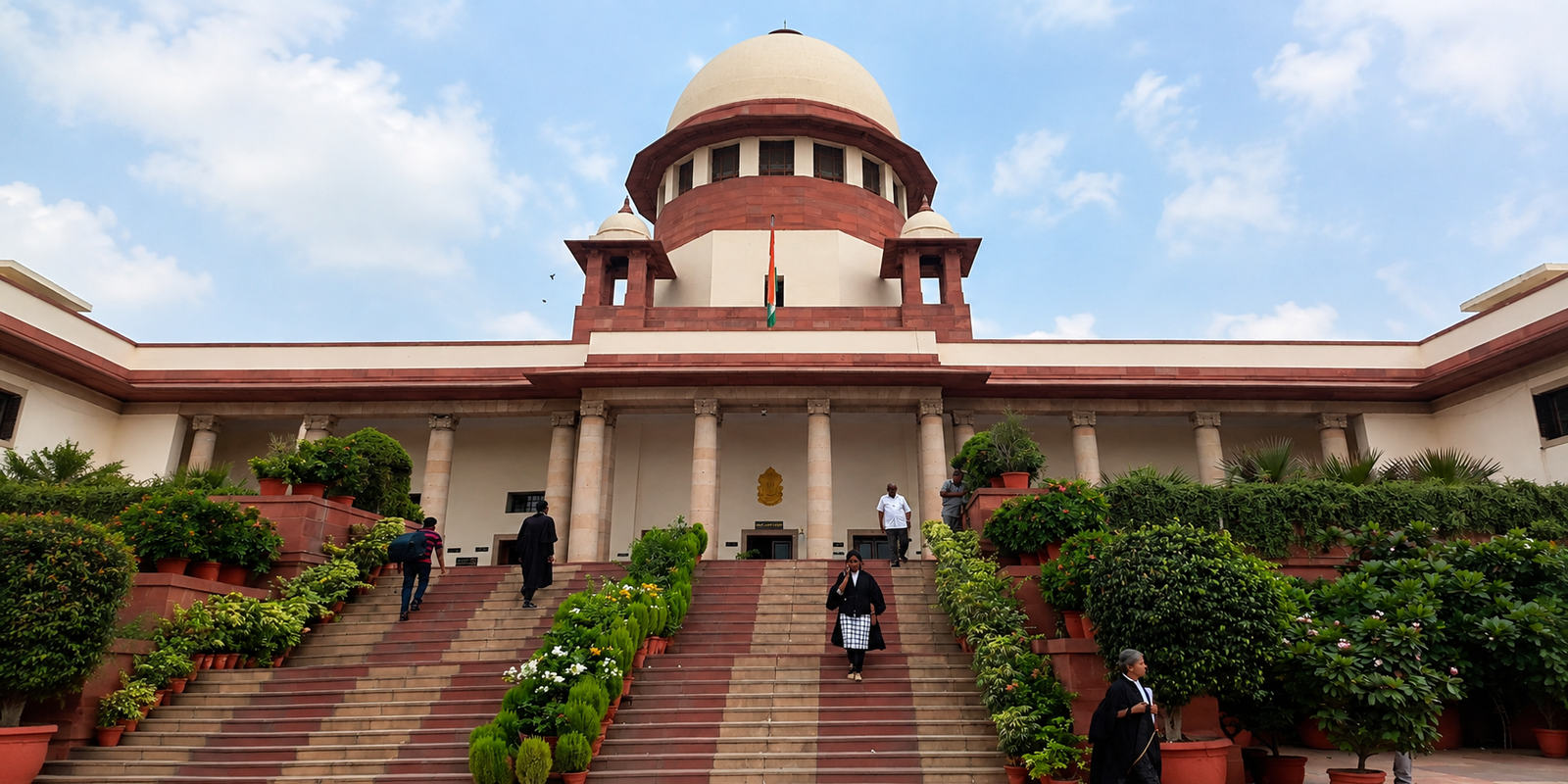

The Advocates Association Bengaluru v. Barun Mitra & Anr.
(Contempt Petition (C) No. 867 of 2021 in T.P.(C) No. 2419 of 2019)
with
Centre for Public Interest Litigation v. Union of India
(W.P.(C) No. 895 of 2018)
Supreme Court of India
Coram: Justice Sanjay Kishan Kaul and Justice Sudhanshu Dhulia
Order dated 20 November 2023
Status: The matter was being heard by a Bench headed by Justice Sanjay Kishan Kaul, which, by its order dated 20 November 2023, directed that it be listed on 5 December 2023. On 5 December, however, the matter was deleted from the cause list. Justice Kaul clarified in Court that he had not directed its deletion and expressed surprise at the non-listing. After Justice Kaul’s retirement, no further substantive order appears to have been passed in these proceedings. In July 2025, when the matter was mentioned again, then CJI B.R. Gavai stated that the issue of pending judicial appointments was being pursued with the Government on the administrative side and agreed to hear the matter. Most recently, on 8 September 2026, the connected petition in Centre for Public Interest Litigation v. Union of India, W.P.(C) No. 895 of 2018, was mentioned before CJI Surya Kant, who agreed to list it.
Introduction
In its last order dated 20 November 2023, the Supreme Court continued its scrutiny of delays in the processing of recommendations made by the Supreme Court Collegium for the appointment and transfer of High Court judges. The Court recorded that several recommendations continued to remain pending with the Union Government and noted that some candidates awaiting appointment were senior to those who had already been appointed. It observed that uncertainty over a candidate’s eventual seniority could make it difficult to persuade other “eligible and deserving candidates” to accept judicial office.
The Attorney General sought further time and assured the Court that efforts were being made to address the outstanding recommendations. Taking note of the assurance, the Court listed the matter for further consideration on 5 December 2023.
Facts and procedural background
The proceedings arose from Contempt Petition (C) No. 867 of 2021, filed by the Advocates Association Bengaluru in proceedings originating from M/s PLR Projects Pvt. Ltd. v. Mahanadi Coalfields Ltd. & Ors. The Supreme Court Registry records that the contempt petition was filed on 25 October 2021 following the Court’s 20 April 2021 order in PLR Projects, which had laid down broad timelines to facilitate timely appointments to the High Courts.
In this, the Court had noted the serious vacancy position in the High Courts and prescribed additional timelines for different stages of the appointment process. The Intelligence Bureau was expected to furnish its inputs within four to six weeks from a recommendation of the High Court Collegium; the Central Government was expected to forward recommendations to the Supreme Court within eight to twelve weeks after receipt of the relevant inputs; and where the Supreme Court Collegium unanimously reiterated a recommendation, the appointment was to be processed within three to four weeks. The Court had characterised the appointments process as a collaborative exercise requiring promptness from all constitutional actors.
The contempt proceedings were subsequently heard together with Centre for Public Interest Litigation v. Union of India, W.P.(C) No. 895 of 2018, another proceeding concerning the judicial appointments process.
The question of delay had already received pointed attention in the 11 November 2022 order. The Court then observed that duly recommended and reiterated names had remained pending for considerable periods and warned that keeping recommendations in abeyance could operate as a device compelling candidates to withdraw. It reiterated that once the Government’s reservations had been considered by the Collegium and a recommendation was reiterated, continued inaction was not acceptable.
When the proceedings resumed in 2023, the Court initially recorded some movement. By its order dated 9 October 2023, it noted that a large number of High Court recommendations which had remained pending with the Ministry had finally been forwarded to the Supreme Court Collegium. The Court made clear that, where a name had been recommended for the first time, the Government should either proceed with the appointment or return the recommendation with its objections. It further recorded that fourteen of twenty-six transfer proposals had been cleared, while the remainder were under process, and observed that the timelines governing judicial appointments ought to operate without requiring continuous monitoring by the Court.
Progress nevertheless remained incomplete. On 7 November 2023, the Court recorded its concern over the continuing pendency of transfer and appointment proposals. It noted that transfer recommendations had been implemented selectively and that fourteen recommendations remained pending without a response from the Government. The Court further observed that selective appointments from a common set of recommendations could disturb the inter se seniority of candidates and make it more difficult to persuade successful members of the Bar to join the Bench.
The Attorney General sought time to hold what the Court described as a “fruitful discussion” with the Government, and the matter was consequently listed for 20 November 2023.
Submissions before the Court
At the hearing on 20 November 2023, Senior Advocate Dushyant Dave, appearing on the petitioners’ side, urged the Court to take a more coercive course. He submitted that the time had come to issue a writ of mandamus directing the Union Government to act upon the pending recommendations within twenty-four hours. In support of the submission, Dave relied upon Supreme Court Advocates-on-Record Association v. Union of India, the Second Judges Case (1993), while pressing the Court to enforce the constitutional position governing judicial appointments. His submission was also made against the background of the timelines already prescribed in PLR Projects case.
The petitioners’ demand for stronger judicial intervention had been foreshadowed at the preceding hearing. On 7 November 2023, Advocate Prashant Bhushan urged the Court to adopt a stricter approach after repeated opportunities had been given to the Government and submitted that the Union was effectively exercising a veto over recommended names. Senior Advocate Arvind P. Datar described the delay in acting upon recommendations as a longstanding problem that had persisted across different governments. He urged the Court to lay down an enforceable rule under Article 141 of the Constitution and prescribe a timeline so that repeated recourse to the Supreme Court would not be necessary.
For the Union Government, Attorney General R. Venkataramani informed the Court that there had been progress in relation to the reiterated recommendations and sought further time. He stated that several matters were in the process of being cleared and requested that the matter be taken up after another week or ten days. The signed order records his assurance that the Court “will not be disappointed” considering the efforts being made by him.
Court’s consideration
The Court examined the status of the recommendations that continued to remain pending. Of the eleven transfers awaiting implementation, five had been effected, while six remained pending: four from Gujarat and one each from Allahabad and Delhi. The Court noted that, in relation to transfers of judges from one High Court to another, it had earlier observed that the Government had “little to do”. Eight recently recommended candidates had also not been cleared for appointment, some of whom were senior to candidates whose appointments had already been notified. The Court observed that uncertainty regarding the seniority at which a candidate would eventually stand as a judge could make it difficult to persuade other “eligible and deserving candidates” to accept judicial office.
The Court further recorded that five older recommendations had neither been returned with comments nor progressed, while five other names, which had been reiterated once or twice, also continued to remain pending. The expected timeline for the Government to send its inputs had also expired in respect of three candidates recommended in July 2023, two from Jammu & Kashmir and one from Jharkhand.
The Court also referred to an appointment to the Gauhati High Court, where the warrant of appointment of a senior candidate, who was also a designated Senior Advocate, had initially not been issued. The oath-taking of the other appointees was delayed for some time to facilitate issuance of the senior candidate’s warrant. The Court expressly appreciated the stand taken by the Collegium and the consequent action taken by the Government.
Order
The Attorney General sought further time and assured the Court that it “will not be disappointed” considering the efforts being made by him. The Court accordingly directed that the matter be listed on 5 December 2023.
The Court also recorded the development concerning the Gauhati High Court, where the warrant of appointment of a senior candidate had initially not been issued. It noted that the oath-taking of the other appointees had been delayed for some time to facilitate issuance of the warrant and expressly appreciated the stand taken by the Collegium and the consequent action taken by the Government.